
The second baseman readies himself. Crouches down low, his glove brushing the dirt, leaning forward, a cat preparing to pounce. The pitcher sets and delivers. The batter sends the ball in motion, a swift ground ball that glides over the sea of infield grass, one hop, then another, straight as an arrow. The second baseman is ready for this, tracks the ball on its trajectory, he is calm, he knows where it will go. He creeps in a couple steps and sticks his glove out, knowing how this will play out.
Then the ball is in right field, and the runner is at first. What happened? He looks down and sees a small rock. He didn’t see it before. That’s not fair. He did everything he was supposed to, and yet he couldn’t prepare for this.
Frustrated, he kicks the rock. The second baseman closes his eyes and wonders why the ball couldn’t have simply bounced right into his glove. He keeps his eyes closed and tells himself that it did.
~~
Baseball lives amongst the cobwebs. More than any other sport, it clings tightly to its long and storied history, with those who bow at the altar still speaking in hushed tones about players who debuted a century ago. The sport has changed at a breakneck pace over the last couple decades, but it never forgets its roots, still holds reverence for its disciples that paved the way and spread the good word.
There is something humbling about both the breadth of its past and the sheer force with which it moves forward, the way it refuses to be predictable. It adjusts to the outside world, changes with the rhythms of those who bow in and out of the game. And the game beats on.
But as baseball forces itself forward today, it struggles to shed that tough skin it has built up, refuses to loosen its seams. Baseball faces a identity crisis, but it is not one to do with rules or a different set of numbers. It is one that refuses to believe that the game has changed at all and would rather have the sport stay its course, the one laid out for it years and years ago.
~~
“What do they say, the postseason ad? Let the kids play?” Joe Davis asks his partner, referencing the slick ad campaign MLB had released just days earlier that took a well-deserved swipe at unwritten rules.
“To a point,” replies John Smoltz dryly.
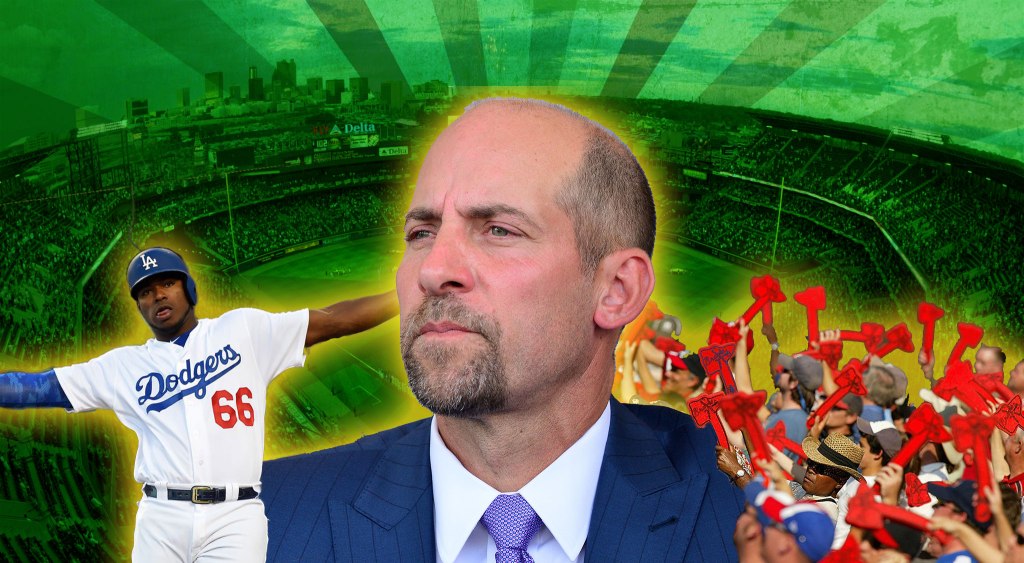
The point in question here is, of course, Yasiel Puig, everyone’s sticking point when it comes to unwritten rules and where you draw “the line.” Smoltz and Davis were discussing a moment in the last half inning, where Puig made a sliding catch to retire Braves first baseman Freddie Freeman, then committed the heinous crime of flipping the ball back to the infield over his shoulder. “You don’t like that?” Davis had said, sounding a bit confused. “No,” said Smoltz through pursed lips.
You can see the supposed offense for yourself above, but it doesn’t really matter what Puig did. He’s a constant target of vitriol that is inextricably tied to his race, whether explicitly or implicity. Though it’s maddening, it’s nothing new.
But the 2018 MLB playoffs have been a crash course in what happens when MLB’s refusal to let go of the past rears its ugly head — with Smoltz as the poster child for it — and it’s the kind of thing that you would think the league would take a greater interest in. On national television, one of baseball’s best pitchers for the better part of two decades, who now acts as the prized commentator for Fox Sports, was overtly pushing the message the league was supposedly seeking to disavow.
It’s easy to roll your eyes at it. Much of Twitter did when Smoltz made the comment, and if it was a one-off moment it might be easy enough to move on. But on nearly every broadcast this postseason, Smoltz has made a point of pushing back against some kind of change in the game, at a time when MLB is very loudly wringing their hands over the idea that no one wants to watch baseball anymore (which isn’t even true, but if it is, it likely has little to do with the on-field product). If you had never watched a baseball game before and happened to flip on the Braves-Dodgers NLDS series, you might wonder to yourself why Fox Sports had hired someone who wasn’t actually a baseball fan to call the game.
Commissioner Rob Manfred has made a point to publicly toy with ideas for how to engage a younger viewership — The War on Pace of Play — and much of it involves a well-placed clock, or changing random rules of the game. And yet the Let The Kids Play advertisement was the first indication that maybe all our yelling into the void on Twitter wasn’t for nothing, that the league was starting to realize that the issue with baseball isn’t that games are a few minutes longer than they were a decade ago, or that pitchers are too good; the biggest issue that imperils baseball’s future is the culture that clouds it.
~~
Of course, all of this neither begins nor ends with Smoltz, but he has the biggest platform and is an easy scapegoat, and deserves the derision that has come his way this October. And yet on Indigenous People’s Day, 42,000 fans in Atlanta — many of them white — pretended to be Native Americans, while the Cleveland Indians played their final game donning a racist caricature of one. John Smoltz might want it to be 1990 again, but Braves fans would have it be a hundred years earlier, and all in the name of “tradition.” Because we aren’t allowed to acknowledge that the world changes. We aren’t allowed to acknowledge that sometimes you learn that we used to do a lot of racist shit and just because it’s a part of our past doesn’t mean it has to be a part of our future.
We’ve had a lot of discussion on Tipping Pitches about baseball’s tight-lipped culture, and frankly it’s just as easy to feel hopeful as it is cynical about where we are. You watch players like Ronald Acuña Jr., Francisco Lindor, Javier Báez, and yes, Yasiel Puig, and it’s easy to feel like we’re living in a golden age of shattering unwritten rules, of breaking through the suffocating culture that implores players to keep their heads down, and of celebrating the game’s diversity instead of mocking it. And yet the playoffs have felt like a setback, a reminder that the outside world is not so kind, is more resistant to change.
Baseball is, supposedly, America’s pastime. It is bound to our history and we treat it as holy. But we also have a strange desire for it to be stuck in time, to remain removed from the outside world while simultaneously removing the outside world from it. Pretending that baseball stands still while everything else moves forward is at best irresponsible, and at worst it is precisely responsible for harboring the very ideologies we seek to oust from society.
~~
Trying to figure out baseball’s moral code is like trying to figure out how the hell they drew a gerrymandered district. It runs thin here, but wide here, and curves right in this very spot, so we can keep all the players who serve our interests, all the fans that do, and discard the ones who don’t. Baseball is a business, and the goal is to have as many people who make the product look good as possible.
All of it, essentially, says the same thing, and the message is this: put your head down and play, and we won’t have a problem. Don’t ruffle feathers. Don’t try to make a statement. Don’t you dare try and change all this. This is sacred. Just do what you came here to do, and we won’t have a problem.
Why do we not welcome the change? Doesn’t it instead give us something new to get excited about? Amidst our obsession with tradition and history, we lose sight of the fact that this is a game for entertainment, a bunch of men in tight pants running around hitting balls with sticks. And yet we throw a temper tantrum when we can’t imitate other cultures in the stands, or when someone on the field smiles a little too wide. Spitting on the field is welcomed, encouraged even, but as soon as the manager pulls his starter a little too early, the sanctity of the game is ruined.
I understand trying to cling to tradition. It is grounding, it reminds us of when we were younger, and we don’t have to admit that we were wrong. But we should open our arms to the change, instead of gatekeeping the sport. Baseball is good. It’s fun to watch! We should welcome as many people into is as possible, whether they’re in the stands or on the field. The game only passes you by when you try to hold onto something that is no longer there. For too many people, baseball exists in a past time. That needs to change.
Imagine trying to figure out this system for the first time. If you had never watched baseball before this postseason, and decided to tune in to see what all the hype was about, you’d see a lot of stuff that seems out of place. You’d hear a lot of people railing against the game being played, lamenting that things aren’t like the good old days. I wouldn’t blame you if you didn’t decide to watch again.
~~
The second baseman opens his eyes again. The runner is still at first. The pitcher looks slightly miffed, but otherwise forgiving. The crowd shuffles their feet. A few throw their hands up in disgust. They couldn’t see the rock, not sure where things went wrong. Most shrug, knowing that the game will keep moving. Their team is up, this means nothing. And the man on first is the fastest in the league. A late-inning ground ball has thrust a little life into the lazy afternoon.
Sighing, the second baseman readjusts his cap, then turns around to receive the throw in from the right fielder. When he gets the ball, he runs his fingers over the now slightly dirtied cowhide. There’s a mark where the bat hit the ball, the agent that put it in motion in the first place. There’s a scuff where it hit the dirt, the moment things changed. They are real. He can feel it.
He throws the ball back to the pitcher, and readies himself again.
 Tipping Pitches